



Wrist Blood Pressure Monitor
Established in March 2017 and located in China, Shenzhen Taikang Medical Equipment Co., Ltd. specialized in the R&D, production and sales of medical equipment. We specialize in producing Bluetooth Wrist Blood Pressure Monitor, Wrist Blood Pressure Monitor Rechargeable, Wrist Blood Pressure Monitor Alkaline Battery, Wrist Automatic Digital Blood Pressure Monitor, and other Wrist Blood Pressure Monitor.
Quickly Efficiency
Our factory operates on highly efficient and streamlined processes, ensuring that our production lines run smoothly and quickly.
Quality Assurance
Our company have CE, FDA, SGS, ISO13485 and other certificates and a large number of design patents.
OEM & ODM Available
We are able to adapt to changing market demands and customize products to meet our customers' specific needs.
Advanced Equipment
We have advanced equipment such as Dielectric strength tester , Ground impedance tester, Oscilloscope Fetal heart simulator, Non-invasive blood pressure simulator, Precision digital pressure gauge, Soldering iron temperature tester to produce better products for you.
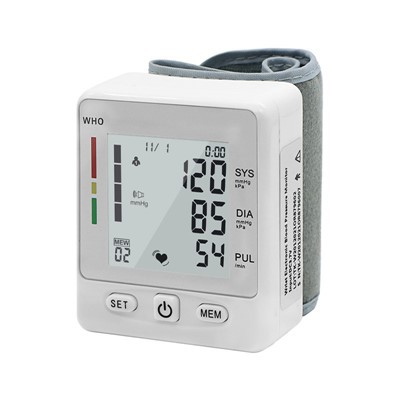
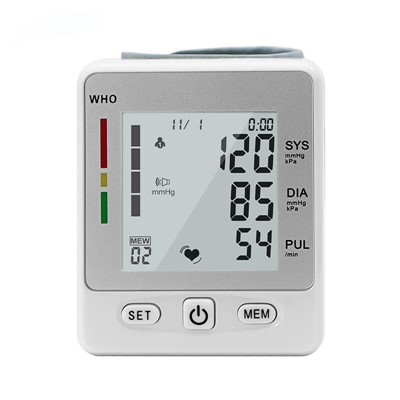


A wrist blood pressure monitor is a device you use on your own to measure your blood pressure (BP). Most monitors have a cuff that you wrap around your wrist. The cuff attaches to a digital display screen that shows your BP readings. If you want to know the specifications and prices of Wrist Blood Pressure Monitor, please contact us!
Portability and Convenience
Wrist blood pressure monitors are small, lightweight, and portable. Their compact design makes them easy to carry, allowing users to monitor their blood pressure at home or on the go.
Easy to Use
Wrist monitors are generally user-friendly. Users can easily strap the device onto their wrist and initiate a blood pressure measurement with the press of a button. This simplicity encourages regular use.
Comfort for Certain Individuals
People with larger arm circumferences or those who find traditional upper arm monitors uncomfortable may prefer wrist monitors. This can be particularly advantageous for individuals with conditions such as obesity or arm injuries.
Digital Display for Easy Reading
Most wrist blood pressure monitors have digital displays that show readings clearly. This makes it easy for users to interpret their blood pressure values without the need for additional interpretation.
Home Monitoring and Trend Analysis
Wrist monitors facilitate home blood pressure monitoring, allowing individuals to track their readings over time. This longitudinal data helps users and healthcare professionals identify trends and patterns, aiding in the management of hypertension.
Affordability
Wrist monitors are often more cost-effective than some advanced upper arm models. This affordability makes them accessible to a broader range of users who want to monitor their blood pressure regularly without a significant financial investment.
Memory and Data Storage
Many wrist blood pressure monitors come equipped with memory functions. This feature enables users to store multiple readings, providing a historical record of their blood pressure measurements. Some models also allow users to review trends and averages over time.
What are the Different Types of Wrist Blood Pressure Monitors?
Manual Blood Pressure Monitors
Mercury
This consists of a cuff that wraps around the arm, a rubber squeeze bulb and a mercury column that measures the blood pressure. A stethoscope is required to listen to the blood pounding through the artery. The blood pressure can be seen on the mercury column as the mercury moves up and down when the pressure in the cuff rises or falls. Mercury blood pressure monitors were a gold standard to monitor blood pressure until recently. However, due to the increased environmental hazard with mercury, doctors are slowly replacing this blood pressure monitor with aneroid or automated ones.
Aneroid
This consists of a cuff that wraps around the arm, a rubber squeeze bulb and a gauge that measures the blood pressure. A stethoscope is required to listen to the blood pounding through the artery. The blood pressure can be seen on a circular dial of the gauge as the needle moves around and the pressure in the cuff rises or falls.


Electronic blood pressure machine
This is similar to a mercury instrument. Instead of mercury, it contains an electronic column that rises and falls. It consists of a cuff that wraps around the arm and a rubber squeeze bulb. A stethoscope is required to listen to the blood pounding through the artery.
Automated blood pressure monitors
This involves an electronic device that will also have a cuff that wraps around the arm. To inflate the cuff, either use a rubber squeeze ball or a push-button, depending on the device.
Once the cuff is inflated, the pressure drops automatically. The screen will show digital readings of the systolic and diastolic blood pressure.
Once the screen shows the reading, the cuff will deflate on its own. Before repeating the measurement, wait for two to three minutes. Digital monitors are the best choice for most people.
How do I Use a Wrist Blood Pressure Monitor?
Before using your new device, take it to your healthcare provider to check it for accuracy. Your provider can measure your BP on the wrist monitor and compare it against an upper arm monitor in the office. This will help show if your device can give you accurate readings at home.
To get the most out of your monitor, you should:
●Use the proper form.
●Keep a blood pressure log and share it with your healthcare provider.
●Learn what's normal for you.
Use the Proper Form
Having the wrong form when using your monitor can lead to inaccurate BP readings. When you take your device to your provider, ask them to show you the proper form. It can help to see and practice the form before trying it on your own.
At home, follow these guidelines:
●Avoid coffee, tobacco products and exercise for 30 minutes before taking your BP. Also, use the bathroom and sit still for five minutes before getting started.
●Choose which arm you'll use. This is the arm that needs to have proper form. Your other arm can be wherever is most comfortable for you.
●Sit in a chair with your feet flat on the floor.
●Position your chair so you have a flat surface (like a table) right in front of you.
●Put the cuff on your wrist and secure it in place.
●Place your elbow onto the table.
●Gently place your hand on your chest so that your wrist is at the level of your heart.
●Relax and stay in this position before starting your BP measurement.
●Measure your BP without moving or talking.
When measuring your BP, it's important to avoid:
●Having your wrist above or below the level of your heart.
●Resting your wrist on the table or your lap.
●Having your arm in a vertical position (like hanging down at your side).
Keep a Blood Pressure Log
Your device may store BP readings in its memory. Even so, you should write down all of your BP readings in a notebook that you can share with your provider. You may also find blood pressure logs online that you can download and print.
Ask your provider what you should record in your log. Here are some general tips to get you started:
●Include the date and time of each reading.
●Take your BP twice per day — such as before breakfast and before bedtime. Each time, take two measurements with about one minute in between. This means you would have four readings per day in your log. Your provider will give you guidance about how many days per week to check your blood pressure.
●Write down notes that seem relevant for the day. For example, make a note if work was very stressful, you had trouble sleeping or you felt sick. Your provider may also want you to write down when you take certain medications.
Learn What's Normal For You
Some people naturally have lower blood pressure, such as 90/60 millimeters of mercury (mmHg). For others, such low BP could signal a problem. Before you start using a wrist blood pressure monitor or another at-home device, it's important to ask your healthcare provider:
●What's a normal blood pressure range for me?
●What BP would be high for me?
●What BP would be low for me?
●When should I call you about my BP readings?
When Might I Need a Wrist Blood Pressure Monitor?
You may need a wrist BP monitor if your healthcare provider wants you to monitor your BP at home. At-home monitoring can be helpful if:
-
You received a high blood pressure (hypertension) or low blood pressure (hypotension) diagnosis.
-
You have risk factors for high blood pressure.
-
You're starting new blood pressure medication and your provider wants to see how well it's working.
-
You're pregnant.
-
Your provider thinks you have white coat hypertension (high BP at your provider's office but not at home) or masked hypertension (high BP at home but not when your provider checks it).

How to Buy the Best Blood Pressure Monitor for You
Make sure the blood pressure monitor you choose has a cuff that fits the circumference of your upper arm or wrist. (Use a tape measure to be certain.) Using a cuff that's the wrong size can result in inaccurate readings. Most of the arm models we tested have two cuffs or a cuff that can be adjusted to fit most people. Wrist models also fit most people.
The recommended models in the ratings (available to members) were priced from $40 to $100. But shop around. And find out whether your insurance covers blood pressure monitors.
The display on the monitor should be easy to read. The buttons should be large and intuitive. The directions for using the cuff and operating the monitor should be clear.
There are many features to look for when selecting a blood pressure monitor. Here are some to consider: an irregular-heartbeat detector, a risk-category indicator, multiple user memories, multiple cuffs, memory download capability, a large-digit display, and a data-averaging function.
What is the Difference Between a Arm Blood Pressure Monitor and a Wrist Blood Pressure Monitor?
Wrist Blood Pressure Monitor
Advantages:
●Portability and Convenience
●Ease of Use
●Comfort for Some Users
●Quick Readings
●User-Friendly Interface
Disadvantage:
Accuracy Concerns
Wrist monitors may be less accurate than upper arm monitors, and their readings can be affected by body position and movement.
Positioning is Critical
Proper positioning of the wrist at heart level is crucial for accurate readings, and this can be challenging for some users.
Not Suitable for Certain Conditions
Wrist monitors may not be suitable for individuals with certain conditions, such as vascular diseases or irregular heart rhythms.
Arm Blood Pressure Monitor
Advantages:
Accuracy
Arm monitors are generally considered more accurate than wrist monitors. They are recommended for clinical settings and may be preferred by healthcare professionals.
Consistent Readings
Readings are less likely to be affected by body position or movement, providing more consistent and reliable results.
Wide Cuff Options
Arm monitors usually come with adjustable cuffs suitable for a range of arm sizes, ensuring a proper fit for accurate readings.
Disadvantage:
Size and Portability
Arm monitors are bulkier and less portable compared to wrist monitors, making them less convenient for travel.
May Be Less Comfortable
Some users find the inflation and squeezing of the arm cuff uncomfortable, especially if they have sensitive or injured arms.
More Complex Usage
Arm monitors may have a steeper learning curve, and users may need to follow more specific instructions for proper use.
Certifications


Frequently Asked Questions
Q: Is wrist blood pressure monitor accurate?
Q: Is care touch wrist blood pressure monitor accurate?
Q: How much higher is BP on wrist?
Q: How tight should wrist blood pressure cuff be?
Q: Are wrist BP monitors higher or lower?
Q: Why is blood pressure different in each wrist?
Q: How accurate are at home blood pressure monitors?
Q: What is a blood pressure monitors used for?
Q: Can you use a blood pressure monitors on yourself?
Q: How do you check blood pressure with a blood pressure monitors?
Q: Can we check BP without blood pressure monitors?
Q: How do you read blood pressure monitors?
Q: Can you use a blood pressure monitor on yourself?
Q: What is the most commonly used blood pressure monitor?
Q: Which is better digital or manual blood pressure monitor?
Q: Do nurses use blood pressure monitor?
As one of the most professional wrist blood pressure monitor manufacturers and suppliers in China, we're featured by quality products and low price. Please rest assured to wholesale cheap wrist blood pressure monitor for sale here from our factory. Contact us for quotation.