

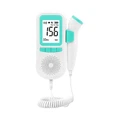


There are two main types of medical nebulizers: medical ultrasonic nebulizers and medical compression nebulizers.
1. The principle of medical ultrasonic nebulizer is that the high-frequency current generated by the ultrasonic generator passes through the ultrasonic transducer to convert the high-frequency current into sound waves of the same frequency, and the ultrasonic wave generated by the transducer passes through the sound-transmitting film at the bottom of the atomization cup, so that the ultrasonic wave directly acts on the liquid in the atomization cup. When the ultrasonic wave is conducted from the bottom of the cup to the surface of the liquid medicine, after being subjected to the action of ultrasonic waves perpendicular to the interface, a tension wave is formed on the surface of the liquid medicine, and with the enhancement of the surface tension wave energy, when the surface tension wave energy reaches a certain value, the tension wave crest on the surface of the liquid medicine also increases at the same time, so that the liquid mist particles at the peak fly out. Due to the uniform size and very small momentum of the fog particles produced by ultrasound, they are easy to follow the air flow. The ultrasonic nebulizer splits the liquid medicine into particles, and then generates a drug mist by the air flow generated by the air supply device, which is delivered to the patient through the fog supply tube. 2. The principle of medical compressed atomizer is to generate and transmit aerosol through the compressed air generated by the compressor as the driving source. When the compressed air generated by the compressor is sprayed out of the nozzle, the chemical liquid is sucked upwards through the negative pressure generated between the nozzle and the suction pipe. The liquid sucked up hits the upper septum, turning into an extremely fine mist and spraying outward. The mist is delivered to the patient through a nozzle or mask. Precautions for the use of nebulizer 1: Cough up the sputum before treatment so as not to hinder the depth of the fog droplets. Take a sitting, semi-sitting or lateral decubitus position during nebulization inhalation, try to avoid supine position, and raise the head of the bed by 30 percent when supine position is necessary. During treatment, the patient inhales slowly and deeply, stopping at the end of the inspiration for a moment, which allows the droplets to be inhaled more deeply.
2. The atomized liquid is prepared fresh every day. Usually inhaled for 10~20 minutes each time, 2~3 times a day, a course of treatment for 1~2 weeks. Inhalation must be done with a small dose and gradually increase the dose as you get used to it until you have absorbed all of the solution. Do not start with large doses, as the rapid entry of large amounts of cold mist into the airways can spasm the smooth muscles of the airways, resulting in increased breath-holding and dyspnea.
3. For patients treated with long-term nebulizer inhalation, the amount of nebulization used must be moderate. If the humidification is excessive, it can lead to an increase in sputum, and when the critically ill patient is delirious or the cough reflex is weakened, the condition can often worsen or even die because the sputum cannot be coughed up in time. If the humidification is not sufficient, it is difficult to achieve the therapeutic purpose.
4. During atomization inhalation, water vapor can humidify the airway well, but the sprayed mist has a certain pressure, which repels the air around the mouth and nose into the respiratory tract and reduces the inhalation of oxygen. Therefore, for patients with severe wheezing, poor breathing and hypoxia, as well as pneumonia and heart failure, it is necessary to improve the above symptoms and increase the amount of oxygen before nebulizing inhalation, and the inhalation time should be short rather than long, about 5 minutes each time, to prevent aggravation of hypoxia.
5. During the nebulization inhalation, it is necessary to pay attention to the changes in the condition. If symptoms such as cough and shortness of breath appear, you should immediately stop nebulized inhalation, increase oxygen inhalation, pat your back, drink water, and consider the next nebulized inhalation treatment when the symptoms are relieved. At the same time, check whether the temperature, dosage and position of the nebulizer are appropriate, and make necessary adjustments. Pay attention to patting the patient's chest and back within 1~2 hours after treatment, and encourage the patient to cough.
6. Some drugs used for nebulized inhalation, such as phlegm Yijing, biyuping, A-chymotrypsin, hypertonic saline, etc., cannot stimulate the bronchial tube and cause reflex bronchospasm, which is especially prone to bronchial asthma patients. Therefore, bronchodilators should be inhaled preceding or at the same time if necessary. In particular, patients with status asthma should be extra careful.
7. In order to avoid the cross-infection of the respiratory tract of nebulization inhalation therapy, it should be done: the nebulizer must be strictly disinfected before use and replaced once a day; when not in use, there should be no liquid in the whole system to avoid bacterial breeding; and sterile solution should be used during nebulization treatment.